Perpustakaan Nirkabel Project at Ketapang Kalimantan Barat
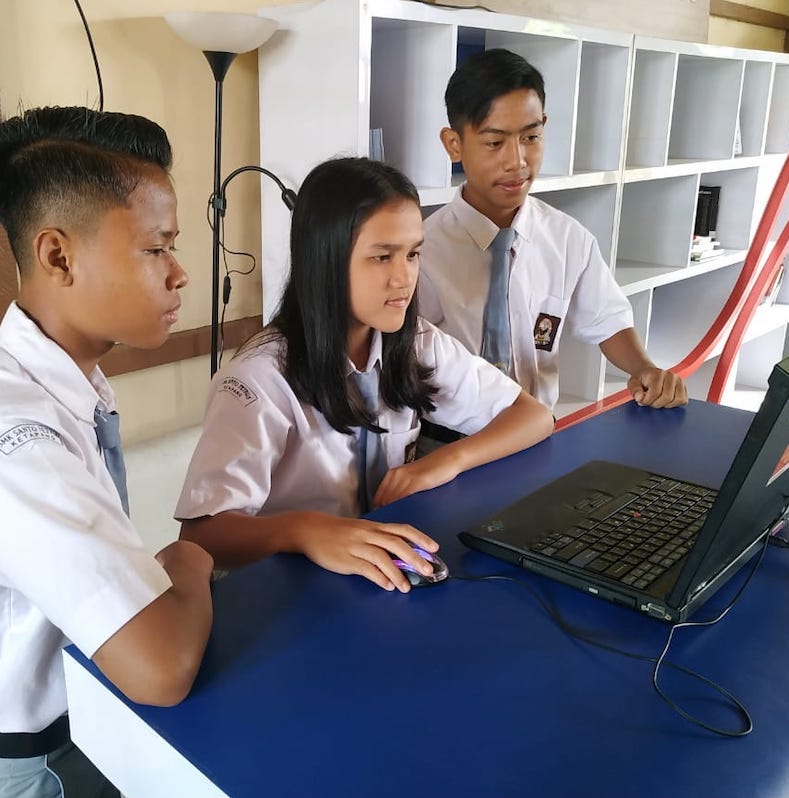
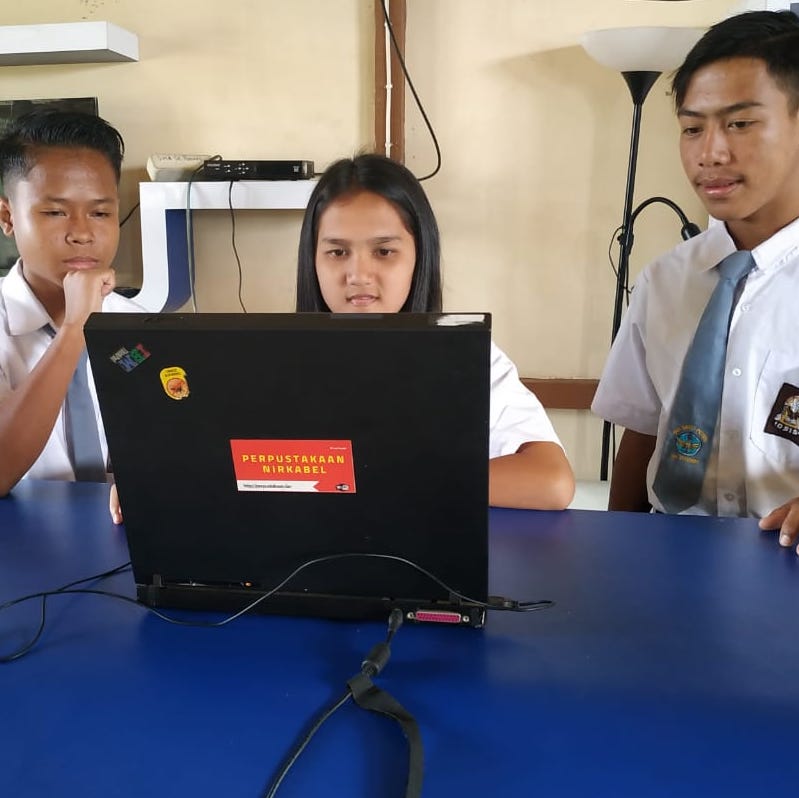
One unit of the Perpustakaan Nirkabel project is present in a formal school in Ketapang City, West Kalimantan. Being located in a formal educational institution, the project in Ketapang successfully recycled a 16-year-old laptop, the oldest among all laptops ever recycled by this project until 2019.
The laptop placed in Ketapang was manufactured in 2003. Its physical condition was excellent when received from the donor. The only essential component that needed replacement was the CMOS (Complementary metal–oxide–semiconductor) battery for the internal clock. The laptop would not function if the CMOS battery completely died.
Assuming normal usage, the CMOS battery would fail to function again in 2025. The laptop can still continue to function by replacing the battery with a component cost of less than Rp20,000 (approximately one US dollar), disregarding the installation cost, which may be in the three-digit range. It is possible for this tool to continue working for three decades since its inception.
This laptop uses Pentium-M processor, which does not fully implement Physical Address Extension (PAE) technology. PAE was only introduced in laptops manufactured after 2005. This transition complicates the selection of the operating system.
Not all Linux distributions can run on non-PAE Pentium-M. Out of all the versions that have been tried, only three Linux distributions can run on this laptop, namely Bodhi Linux, Puppy Linux, and Tiny Core. After some modifications, Bodhi Linux was chosen because it is the easiest to use and learn for beginners.
There are still Linux distributions for Pentium-powered computers that have not been tested. Due to its age, this tool is placed in a location that is relatively comfortable for a laptop: abundant electricity, disciplined users, and secure storage.
Until 2019, this project placed one unit in an urban area of Kalimantan. The placement model in formal schools is unusual for this project. Typically, this technology is provided to informal educational locations.
The placement model in formal schools is one form of experimentation (social experiment) regarding the concept of formal and informal wireless digital education. In the coming years, which one will be more successful in making a concrete impact on society: placing wireless libraries in formal or informal educational institutions; urban or rural areas?
Considering the electricity needs, almost all Wireless Library projects that use laptops are located in urban areas. Only two [confirmed] laptop versions are placed in rural areas: one in Siberut Island, Mentawai Islands, and the other in the Mount Binaiya climbing basecamp in Piliana Village, Seram Island, Maluku.
 |
|---|
| Laptop edition of the Perpustakaan Nirkabel in Ketapang, West Kalimantan. This library is in the city's formal school library. Photo: Tri Sunarto |
| :--: |
 |
| :--: |
| This project has succeeded in extending the life of Pentium technology laptops. The age of the laptop and user in this photo is more or less the same. Photo: Tri Sunarto |
| :--: |
